
I never set out to invent a medical device.
Like many things in medicine, PessaryAssistant™ began with a simple, recurring problem I kept seeing in my own patients.
As an Ob/Gyn physician in Chattanooga, Tennessee, I routinely cared for women using vaginal pessaries to manage pelvic organ prolapse. While pessaries are an excellent non-surgical option, many patients—especially those with arthritis or decreased hand strength—struggled with one key issue:
placing and removing their pessaries independently.
Over time, I realized this wasn’t just an inconvenience—it was a barrier.
Some patients avoided pessaries altogether. Others left them in too long, increasing the risk of complications.
That problem became the starting point for PessaryAssistant™.
A Simple Idea, A Real Need
The goal was never to change the pessary itself.
Instead, I wanted to create a simple pessary insertion and removal aid that could:
- help hold a folded ring pessary for easier placement
- assist with removal using minimal grip strength
The concept was simple.
But turning it into a reliable, easy-to-use tool took years of iteration.
The First Prototype (and an Unexpected Stop at a Library)
One of the most pivotal moments happened during a family vacation.
Before committing to machining the design, I needed to physically test it. A quick search led me to a public 3D printing lab at a library in Bluffton, South Carolina.
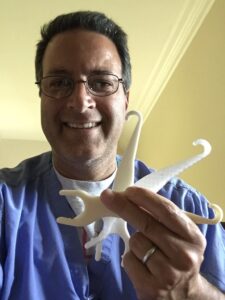
With their help, we printed an early prototype in clear plastic.
Holding that first version in my hands changed everything.
It confirmed the concept—and gave me the confidence to move forward.
From Prototype to Product
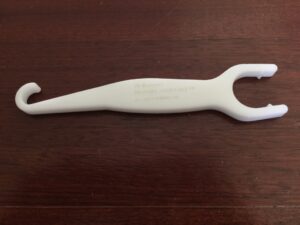
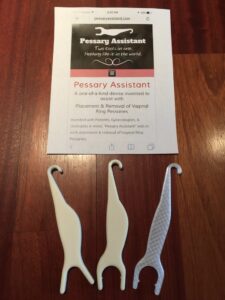
The first 75 PessaryAssistants had been individually made with a 3D printer, taking ~10-15 minutes to produce each one. And with the expensive medical grade plastic, per unit cost was ~$75. Selling them for $50 meant I was operating at a loss of approximately $25 per unit.
The first scaled production run was created using CNC machining from sheets of acetal copolymer.
About 70 units were produced. And cost came down to ~$25 each.
At that point, several things became clear:
- the design worked
- patients wanted it
- manufacturing needed to improve
Early sales were simple:
- directly from my office
- through a basic website
- and eventually on Amazon
There was no formal marketing strategy—just patient need and word of mouth.
Protecting the Idea
In 2016, I filed a design patent for the PessaryAssistant™.
At the same time, I began working on:
- branding
- packaging
- and a more formal product identity
This was the moment it shifted from a helpful idea to a true medical device product.
Scaling Up: Injection Molding
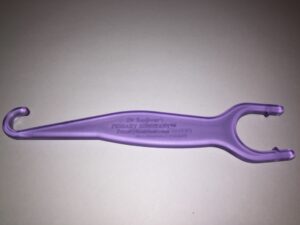
As demand grew, machining became too expensive.
The solution was injection molding, which allowed:
- lower cost per unit
- consistent quality
- scalable production
This was a major turning point in making the device more widely available.
Years of Refinement
The design didn’t stop evolving.
Over the years, I worked with engineers, designers, and manufacturing partners to improve:
- thickness and flexibility
- ergonomics and grip
- hook design for removal
- compatibility with different pessary types
Even small changes required testing, patient feedback, and repeated refinement.
Finding the Right Material
Material selection became one of the most important decisions in the process.
We explored:
- ABS
- acetal
- polycarbonate
- silicone
- polypropylene
Each material had trade-offs.
Ultimately, medical-grade polypropylene provided the best balance of:
- flexibility
- durability
- safety
- manufacturability
The Modern Design (PA0008)
The latest version reflects nearly a decade of refinement.
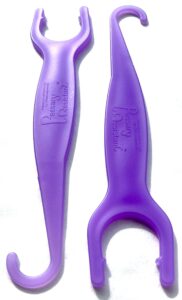
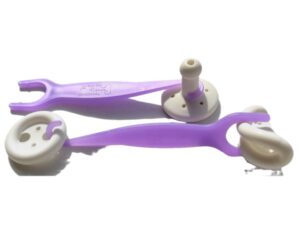
Key improvements include:
- a thinner, more comfortable profile
- a refined “U” side for improved pessary control
- a larger hook to assist with Gellhorn pessaries
- improved balance between strength and flexibility
- optimized embossed text for grip and cleanability
A Tool Designed Around Patients
PessaryAssistant™ was never meant to be complicated.
It does not replace clinical care or alter the underlying treatment.
It is a simple mechanical aid designed to help patients handle, place, and remove their pessaries more easily and independently.
Looking Forward
Even today, the design continues to evolve.
Every patient interaction, every piece of feedback, and every iteration helps refine the tool further.
Because at its core, PessaryAssistant™ was never just about a device—
It was about removing a barrier, restoring confidence, and making a proven treatment option more accessible.